

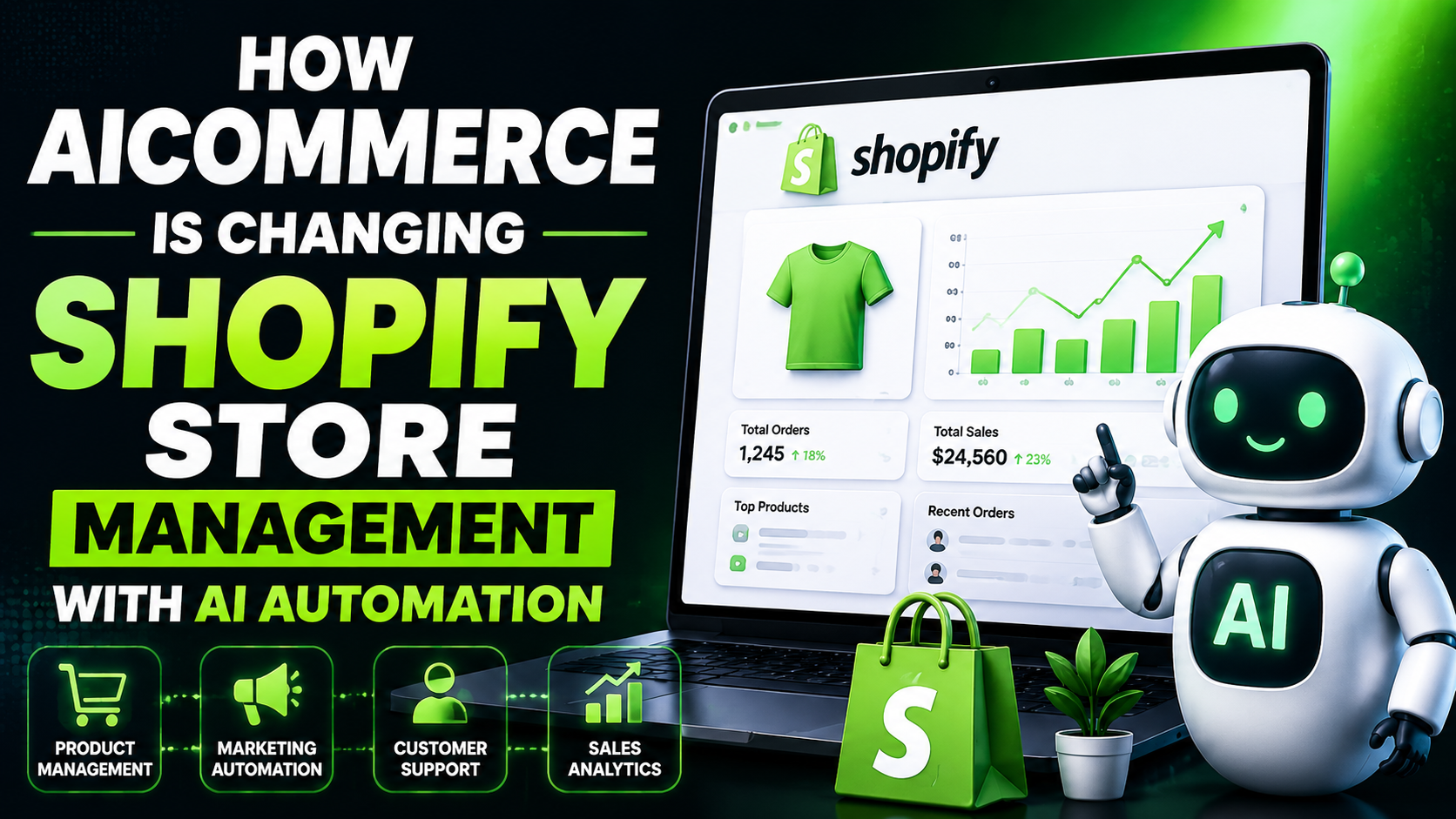
Managing a Shopify store can become increasingly demanding as an online business grows. Entrepreneurs must track products, customer interactions, marketing, sales, and many routine operational tasks at the same time. Artificial intelligence is creating new ways to simplify these responsibilities by supporting repetitive processes and helping businesses organize their workflows more efficiently. AICommerce is part of this shift toward AI-powered e-commerce, focusing on automation and tools that support modern online businesses.
The growing use of artificial intelligence is also changing expectations around store management. Instead of relying entirely on manual work or separate tools for every task, entrepreneurs can explore intelligent systems that support different areas of an online business. This approach can give Shopify store owners more time to focus on strategy, customer relationships, product development, and sustainable growth.
Table of Contents
- Why Shopify Store Management Is Becoming More Complex
- How AICommerce AI Tools Can Support Shopify Businesses
- AICommerce Automation and the Challenge of Business Growth
- The Role of AICommerce AI Marketing and Sales Tools
- Building a More Efficient Shopify Store Management Strategy
- AICommerce and the Future of Shopify Store Operations
- AICommerce Shopify Automation and the Changing Entrepreneurial Role
- Conclusion
Why Shopify Store Management Is Becoming More Complex
Launching a Shopify store may be relatively straightforward, but managing it consistently requires ongoing attention. As product ranges expand and customer numbers increase, routine responsibilities can quickly consume an entrepreneur’s time. Product updates, store organization, marketing activities, sales management, and customer communication must work together for an online business to operate effectively.
This growing complexity is one reason businesses are exploring AICommerce Shopify automation. Artificial intelligence can support workflows that would otherwise require repeated manual input, helping entrepreneurs create more organized operations. Automation does not eliminate the need for human decisions; instead, it can provide additional support so business owners can concentrate on areas where their expertise has the greatest impact.
The Shift From Manual Tasks to Intelligent Workflows
Traditional automation usually follows predefined instructions for individual tasks. AI-driven systems can support more flexible workflows by using artificial intelligence to process information and assist with different operational activities. This gives Shopify entrepreneurs a more connected approach to store management.
For businesses considering an AICommerce Shopify store builder, the broader value goes beyond creating an online storefront. A growing business also needs efficient post-launch processes. AI-supported tools can help entrepreneurs think about store creation, management, marketing, and sales as connected parts of a larger digital business system.
How AICommerce AI Tools Can Support Shopify Businesses
Artificial intelligence is becoming useful across several areas of e-commerce, especially where businesses handle repetitive workflows or large amounts of information. Entrepreneurs can use AI tools to support operations while keeping control of key business decisions. This can be especially useful for Shopify businesses trying to grow without letting administrative work take over their time.
AICommerce focuses on AI-driven solutions designed for online businesses, including tools and automation concepts relevant to modern e-commerce operations. Its approach to AI agents and Shopify-related automation is highlighted in the AICommerce AI agents announcement, which provides more detail on its technology direction.
Areas Where Automation Can Provide Support
Depending on the business and its workflow, AI-powered systems can assist entrepreneurs with areas such as:
- Repetitive store management activities
- Workflow organization
- E-commerce marketing processes
- Business information and operational tasks
- Supporting scalable online business systems
The exact value of automation depends on how a business uses the technology. Entrepreneurs should identify the tasks that consume the most time and determine where intelligent tools can provide practical assistance.
AICommerce Automation and the Challenge of Business Growth
Growth can create new operational challenges for Shopify store owners. A business that is manageable with a small product catalog and limited customer activity can require significantly more coordination as orders, products, and customer interactions increase. Without efficient workflows, entrepreneurs may spend more time managing routine processes than pursuing growth opportunities.
AICommerce automation fits into this broader need for scalable business operations. AI-driven systems can help entrepreneurs streamline repetitive activities and organize workflows as their businesses evolve. The goal is not simply to automate as many tasks as possible, but to build an operating structure that supports productivity and sustainable growth.
Creating More Scalable Online Business Systems
Scalability is an important consideration when adopting new technology. A useful solution should continue providing value as business requirements become more complex. Entrepreneurs can therefore view AI automation not just as a short-term productivity tool, but as part of a broader strategy for building adaptable digital operations.
Information on AI-powered e-commerce scaling and AI agents shows growing interest in using artificial intelligence to support online business expansion. As e-commerce businesses continue adopting AI, scalable automation may become an increasingly important part of store management.
The Role of AICommerce AI Marketing and Sales Tools
Marketing and sales are essential to Shopify store growth, but both require consistent attention. Entrepreneurs need to develop campaigns, understand customer behavior, monitor performance, and adjust their approach as market conditions change. AI can support these areas by helping businesses organize processes and reduce repetitive work in marketing and sales.
The concepts behind AICommerce AI marketing and AICommerce AI sales reflect a broader shift in how entrepreneurs think about digital commerce. AI is no longer limited to a single administrative function. Instead, businesses are exploring how intelligent technology can support different stages of the customer journey while keeping people responsible for strategy, creativity, and brand direction.
Keeping Human Judgment at the Center
Automation works best when it complements human expertise. Entrepreneurs understand their customers, brand values, products, and market better than an automated system can. AI tools can support processes, but business owners still need to make important decisions about pricing, positioning, customer relationships, and long-term direction.
This balance can help Shopify businesses use AI responsibly. Rather than treating automation as a replacement for human involvement, entrepreneurs can use it to reduce repetitive work and create more time for activities that require experience and judgment.
Building a More Efficient Shopify Store Management Strategy
An effective Shopify management strategy should consider both current operations and future growth. Entrepreneurs can start by identifying areas where manual processes create unnecessary delays or take up significant time. From there, they can evaluate whether AI tools can support those workflows without compromising quality or customer experience.
Businesses researching AICommerce eCommerce platform solutions can also consider how AI-powered systems fit into their existing technology stack. The goal should be to create a practical mix of automation and human oversight, not to add technology simply because AI is becoming popular.
Questions Entrepreneurs Should Ask Before Adopting AI Automation
Before introducing AI into a Shopify operation, businesses can consider:
- Which tasks currently require the most manual effort?
- Can automation improve efficiency without reducing quality?
- Will the solution remain useful as the store grows?
- How much human oversight will important processes require?
- Does the technology align with the company’s broader business goals?
These questions can help entrepreneurs approach automation strategically. A thoughtful implementation can make technology more useful while avoiding unnecessary complexity.
AICommerce and the Future of Shopify Store Operations
The relationship between artificial intelligence and e-commerce will likely grow stronger as technology develops. Shopify entrepreneurs are already exploring ways to use AI for store management, marketing, sales, and operational workflows. The next stage of this development may involve more connected systems that can assist with multiple aspects of running an online business.
AICommerce’s focus on automation reflects this broader transition. As entrepreneurs look for ways to build more efficient businesses, AI-powered tools can create opportunities to rethink how routine work gets done. The future of store management may combine Shopify’s e-commerce infrastructure, AI tools, and human decision-making.
Preparing for a More Automated E-Commerce Environment
Entrepreneurs do not need to automate every part of their business to benefit from AI. A more practical approach is to identify processes where automation can provide measurable value and introduce technology gradually. This lets businesses learn how AI fits into their workflows while maintaining control over key customer and operational decisions.
The AICommerce company profile provides another source of information for entrepreneurs researching the company and its professional presence. Reviewing company information alongside technology developments can help businesses better understand the broader context before evaluating AI-powered solutions.
AICommerce Shopify Automation and the Changing Entrepreneurial Role
Automation can change an entrepreneur’s role by shifting attention away from repetitive administrative work and toward higher-value activities. Instead of spending large amounts of time on routine processes, business owners may have more opportunity to focus on product strategy, customer relationships, creative work, and expansion.
This does not mean technology removes the responsibilities of running a business. Successful Shopify stores still depend on strong decision-making, customer understanding, and effective strategy. AI automation can simply provide additional support for entrepreneurs who want to make their operations more efficient.
Creating Better Experiences for Customers
Customer experience remains central to e-commerce success. Faster processes and organized workflows can help businesses respond to customer needs more effectively, but they should always implement technology with the customer in mind.
AI-powered systems can support operational efficiency while entrepreneurs maintain responsibility for communication, brand standards, and customer relationships. This combination can help Shopify businesses pursue automation without losing the human element that makes a digital brand valuable.
Frequently Asked Questions
What is AICommerce Shopify automation?
AICommerce Shopify automation refers to using AI-driven tools and workflows to support Shopify-related business operations. It reduces repetitive work and helps entrepreneurs manage online business activities more efficiently.
How can AI tools help Shopify store owners?
AI tools can support repetitive workflows, operational processes, marketing activities, and other areas of online store management. Their usefulness depends on the business’s specific needs and how the technology is implemented.
Can AI automation help businesses scale Shopify stores?
AI automation can help businesses manage increasing operational complexity by supporting repetitive tasks and workflows. However, successful scaling also requires a strong business strategy, customer understanding, and the right technology choices.
Does AI automation replace Shopify entrepreneurs?
AI automation is better viewed as a support system rather than a replacement for entrepreneurs. Business owners remain responsible for strategy, creativity, customer relationships, and important operational decisions.
What should businesses consider before adopting AICommerce solutions?
Businesses should consider their existing workflows, automation needs, scalability requirements, technology capabilities, and business objectives. Evaluating these factors can help entrepreneurs determine where AI can provide practical value.
Conclusion
AI is creating new possibilities for Shopify store management by helping entrepreneurs handle repetitive work, operational workflows, marketing, and sales more efficiently. AICommerce is part of this broader shift toward intelligent e-commerce systems, giving businesses another technology to consider as they look for scalable approaches to online operations.
The most effective use of AI is likely to come from combining automation with human expertise. Shopify entrepreneurs can identify time-consuming processes, introduce appropriate AI tools, and continue using their own judgment for decisions that require creativity and customer understanding. As e-commerce evolves, AI-powered automation may become an increasingly important part of building efficient and adaptable online businesses.